MVP Cost in 2026: What Founders Pay and How to Budget
On this page
How much does an MVP cost in 2026? Agency price ranges, what drives the number up, and how to turn a budget into one fixed price.
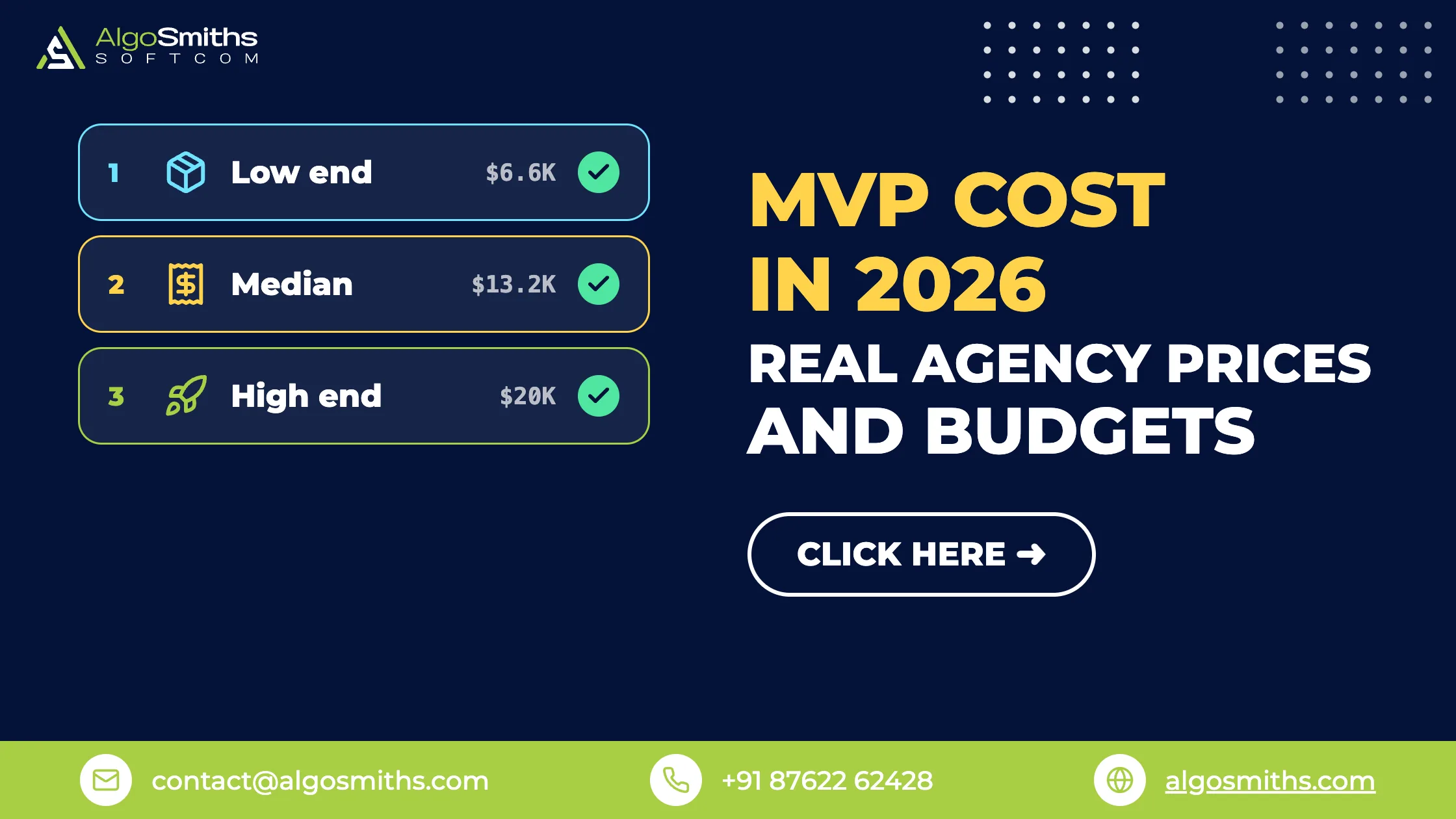
The median agency advertises an MVP starting price near $13,000, and a standard web or SaaS MVP runs from $15,000 to $50,000 depending on scope and where the team works. A founder who limits the first version to one core feature can pay less: our own MVP packages start at $3,499 for one core feature and $6,499 for a complete first version. The price follows the feature list, the number of integrations and whether the product includes AI.
This guide is for founders deciding how much to budget for a first version, and for anyone comparing quotes that differ by a factor of ten. It covers what an MVP costs in 2026, how cost changes with scope, team location and AI, what an MVP costs to run after launch, and a five-step way to turn a fuzzy budget into one fixed price. If your idea is not yet a product, our walkthrough on turning an idea into a working MVP comes first.
Key takeaways
- In an October 2026 review of 95 agency websites, Rocketech found a median advertised starting price of $13,234, with the middle half of agencies starting between $6,617 and $20,000.
- Agencies that describe market-wide ranges instead of their own prices have a median midpoint of $77,500. Compare quotes on written scope, not on headline numbers.
- Location matters. Clutch lists most software companies at $24 to $49 an hour, with US providers at $50 to $99 and Canadian and Australian ones at $100 to $149.
- AI features raise the price: Rocketech found AI MVPs cost a median 4.8 times the standard MVP at the same agencies.
- After launch, expect hosting, a database and error monitoring from about $25 a month for an early product, plus the care you choose to buy.
How much does it cost to build an MVP in 2026?
Plan for $15,000 to $50,000 at a typical agency for a standard web or SaaS MVP, which is the range GoodFirms' MVP cost guide gives, and less if you limit the first version to one core feature. The table shows what each scope tier includes, next to our own packages.
| Scope | What it includes | Typical market price | AlgoSmiths package |
|---|---|---|---|
| One core feature | Sign-up and login, one workflow end to end, deployed | Median advertised starting price: $13,234 | Validate, $3,499, 1 to 2 weeks |
| Complete first version | 3 to 5 core features, admin dashboard, emails and analytics | $15,000 to $50,000 | Launch, $6,499, 3 to 4 weeks |
| Larger product | Several user roles, integrations, AI features or mobile apps | $50,000 and up | Scale, from $12,999, in phases |
Market prices come from the Rocketech index and GoodFirms' guide. Treat them as planning ranges. A written scope with a fixed price is the only figure that counts, and you get it from a quote.
Why do MVP quotes vary so much?
Quotes vary because the scope behind each one differs. One agency prices a web app on a component library and one payment integration. Another prices custom design, native iOS and Android apps and a compliance audit. Both call the result an MVP.
Rocketech's review shows the second reason: of 95 agencies, 24 showed no price at all and 30 gave only a general range. The agencies that stated market-wide ranges averaged a midpoint of $77,500, while the 29 that published their own range had a median midpoint of $23,159. A broad range on a website says little about what that agency charges.
Send every agency the same written feature list and ask for a fixed price against it. The quotes become comparable the moment they cover the same scope.
How does the team's location change the cost?
Location changes the hourly rate, and the hourly rate changes the total. Clutch's September 2026 data puts most software companies at $24 to $49 an hour. By country, US providers charge $50 to $99, Poland at $50 to $99, India, Ukraine, the Philippines and Mexico at $25 to $49, and Canada and Australia at $100 to $149.
| Option | Typical hourly rate | Trade-off |
|---|---|---|
| Freelancer | Varies by market and seniority | Lowest hourly cost. You coordinate design, backend and testing yourself. |
| Agency in India | $25 to $49 on Clutch | A full team at a lower rate. Choose one that works to a written scope and demos weekly. |
| Agency in the US, Canada or Australia | $50 to $149 on Clutch | Same-timezone work for US buyers at a higher rate. |
| In-house hires | Salary, benefits and ramp-up time | Most control and the slowest start. Right after the product finds traction. |
A lower hourly rate only saves money when the scope is locked. An hourly contract with a vague brief costs more than a fixed price at a higher rate. If you are weighing the in-house route, our guide to building a startup tech team on a budget covers the leaner options.
What makes an MVP cost more?
AI features
Rocketech found AI MVPs cost a median 4.8 times a standard MVP at the same firms. Model calls, retrieval over your documents, evaluation and monthly usage fees all add work and running cost. Our guide to the monthly cost of running an AI feature sizes the usage side.
Integrations
Each payment provider, CRM or outside API adds build and test time, plus the work of handling its failures. Count integrations before you ask for a quote.
Platforms
A web app is the cheapest start. Native iOS and Android apps multiply the surface you build and maintain. A React Native codebase shares most code between both phones when mobile matters.
Custom design
Bespoke screens cost several times what a clean component library does. A good component library covers most of what a first version needs.
Compliance
Health data, card data and strict privacy rules add architecture and audit work that you cannot skip. Raise them in the first call.
What does an MVP cost after launch?
An early product with a few hundred users can run on hosting, a database and error monitoring from about $25 a month. Supabase's Pro plan, for example, starts at $25 a month; our breakdown of what a Supabase app costs each month shows how that grows with users and data.
Add three more lines to the budget:
- Iteration: keep about 20% of the build budget for the changes real users ask for in the first months.
- Care: security updates, small fixes and monitoring. Our care plan starts at $249 a month.
- Payment fees: card processors take a percentage of every sale, so they scale with revenue and not with the build.
Where MVP budgets leak
- Scope creep. "While we are at it" turns a $20,000 build into a $50,000 build. Park new ideas in a list for version two.
- Vague requirements. Developers guess, build the wrong thing and rebuild it. You pay twice.
- Designing for scale too early. Infrastructure for a million users, before you have ten, spends money on a problem you do not have.
- AI added before the core works. Validate the main workflow first. Our post on why rushing AI into an MVP backfires explains the pattern.
How to turn a fuzzy budget into one fixed price
- Write the one core job. State the single problem the MVP solves in one sentence. A feature that does not serve that sentence waits for version two.
- Split must-haves from nice-to-haves. Most must-haves are nice-to-haves with a deadline attached.
- Pick a proven stack. A framework that ships authentication, an admin panel and a database layer, such as Django, removes weeks of custom work. Our guide to building MVPs faster with Django shows what that saves.
- Get a fixed price against the written scope. The same document goes to every agency you compare.
- Hold back 20% for iteration. Spend it after launch, on what users do.
Frequently asked questions
How much should I spend on an MVP?
Spend what lets you test one core assumption with real users. For a single-feature product that can mean $3,500 to $13,000. For a complete first version with several features, budget $15,000 to $50,000 at a typical agency, and hold back about 20% for changes after launch.
What is a realistic MVP budget for a startup?
A realistic budget covers the build, the first three months of running costs and the iteration reserve. Rocketech's index puts the middle half of agencies starting between $6,617 and $20,000, so a budget under that range needs a very small scope or a lower-cost team.
How much does an MVP prototype cost?
A clickable design prototype costs a fraction of a working product, because nothing runs behind the screens. A working prototype built with an AI app builder costs little in subscription fees but needs engineering before real users arrive; see our guide to what Lovable credits cost to ship an app.
Can I build an MVP for under $10,000?
Yes, if the scope is one core feature with sign-up, login and a single workflow. Our Validate package starts at $3,499 for that scope. Products with payments, several roles or integrations cost more.
Is a fixed price better than hourly billing for an MVP?
For a defined scope, a fixed price protects you from open-ended hourly bills. It works only once the scope is written down, which is good discipline for the product too.
Set your MVP budget this week
Write the one-sentence core job, list the features, mark which ones the first users need, and send that document to two or three teams for fixed-price quotes. Compare the quotes against the same list and keep 20% for what you learn after launch.
If you want a senior engineer to scope your MVP on a free call and quote one fixed price, see our MVP development service.
Topic: Building an MVP