FastAPI vs Django vs Flask: Choosing a Python Backend
On this page
FastAPI vs Django vs Flask for startups: what each framework gives you, how async and speed differ, and which one fits your product.
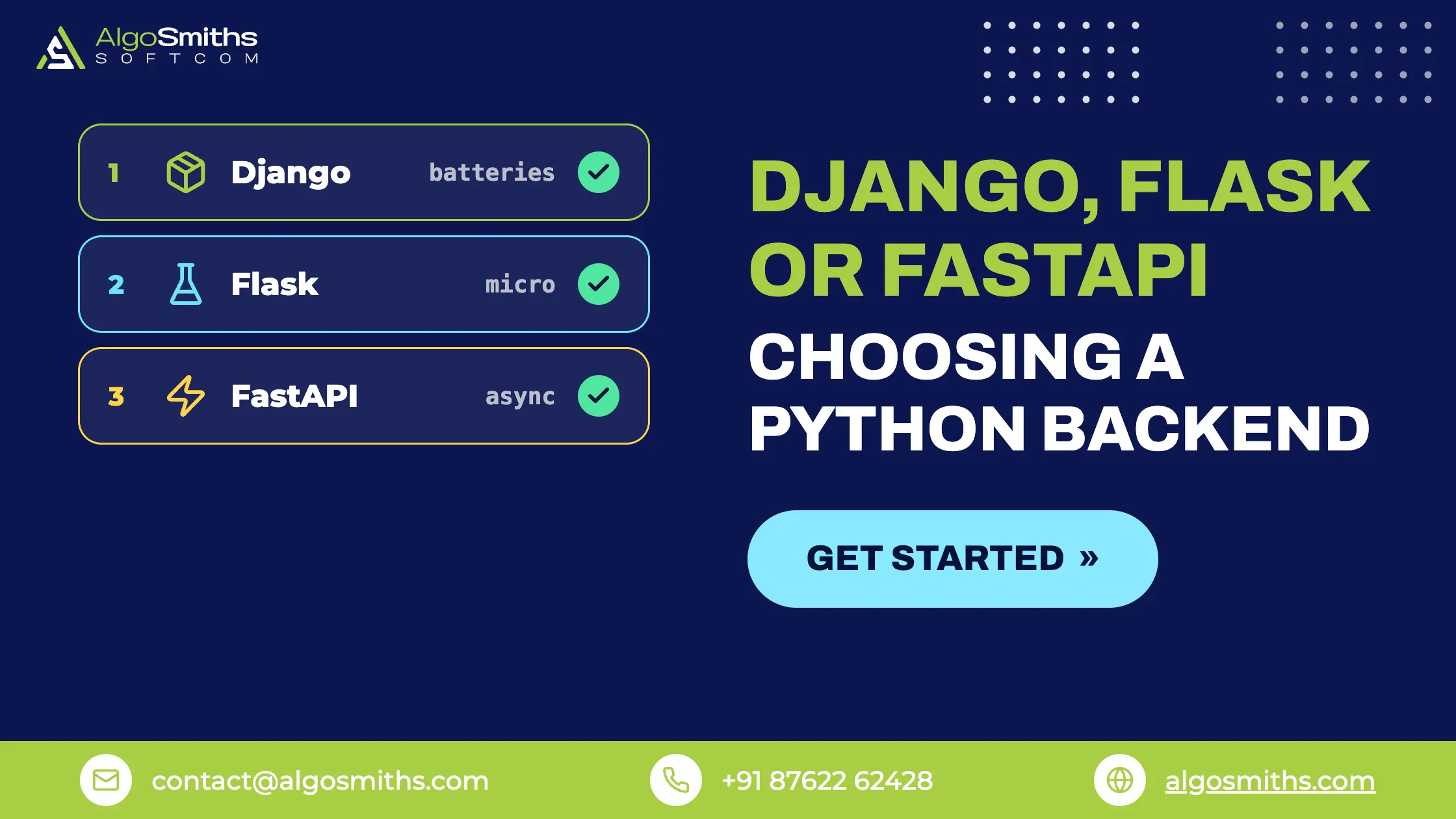
Django, Flask and FastAPI are the three Python web frameworks most teams choose between. Pick Django when you want an admin panel, user accounts and a database layer ready on day one. Pick FastAPI for an API-only backend that spends its time waiting on databases, AI models and other services. Pick Flask for a small service where you want to choose every piece yourself.
This guide is for founders and engineering leads choosing a Python backend for a new product, or deciding whether to move an existing Flask or Django app. It compares what each framework gives you, how they handle async work and performance, which one fits which kind of product, and how teams combine them. If Python itself is still an open question, our comparison of Django and Node.js for a startup backend covers that decision first.
Key takeaways
- Django ships with an ORM, migrations, authentication and an admin panel. Add Django REST Framework or Django Ninja for APIs.
- FastAPI builds on Starlette and Pydantic: async by default, request validation from type hints and interactive API docs generated for you. It has no ORM of its own.
- Flask gives you routing and templates and leaves the rest to extensions. Its async views still occupy one worker per request.
- Most products spend their time in database queries. Fix slow queries before you pick a framework for speed.
- Many teams run two: Django for the admin and core data, FastAPI for AI or high-concurrency endpoints.
Django vs Flask vs FastAPI at a glance
| Django | Flask | FastAPI | |
|---|---|---|---|
| Style | Batteries included | Micro-framework | API-first |
| Database layer | Built-in ORM and migrations | Extensions such as SQLAlchemy | Your choice, such as SQLAlchemy or SQLModel |
| Admin panel and auth | Built in | Extensions | You build or add them |
| Async | Async views; full benefit under ASGI | Async views, one worker per request | Async-first on ASGI |
| API docs | With DRF or Ninja add-ons | With extensions | OpenAPI, Swagger UI and ReDoc built in |
| Fits | SaaS products, marketplaces, back offices | Small services, webhooks, prototypes | API-only backends, AI features, many concurrent calls |
What does each framework give you?
Django
Django gives you the parts most business apps need: an ORM that maps tables to Python classes, migrations that version your schema, user accounts with permissions, and an admin panel your operations team can use from the first week. For APIs, Django REST Framework adds serializers, authentication classes and a browsable API, while Django Ninja offers a FastAPI-style interface with type hints on top of the same Django models.
The cost is structure. Django expects its own project layout and conventions, and a team that fights them writes more code than it saves. Our guide to when Django is the wrong choice lists the cases where that structure gets in the way.
Flask
Flask handles routing, request and response objects and templates. Everything else comes from extensions you pick: SQLAlchemy for the database, Flask-Login for sessions, Marshmallow or Pydantic for validation. A ten-file Flask service stays easy to read. A Flask codebase that grew for three years without a plan can hold three different ways of doing the same thing.
Flask supports async def views since version 2.0, but the Flask documentation states that each request still ties up one worker, even for async views. The number of requests your app can serve at once stays the same.
FastAPI
FastAPI is built on Starlette for the web layer and Pydantic for data. You declare request and response shapes with Python type hints, and FastAPI validates every request against them and publishes interactive API documentation from the same code. Its dependency injection system handles shared pieces such as database sessions and the current user. The FastAPI features page covers each of these.
FastAPI leaves the database, migrations, admin panel and background jobs to you. Teams pair it with SQLAlchemy or SQLModel and Alembic, and those choices take time in week one.
Is FastAPI faster than Django and Flask?
For work that waits on the network, yes: an async framework on an ASGI server can hold many slow requests open without a thread for each. For work that waits on a slow query or heavy computation, the framework makes little difference.
The gap shows up in a few patterns:
- Calls to AI models and outside APIs. An endpoint that waits two seconds for a language model holds a worker for two seconds in a sync framework. FastAPI keeps serving other requests in that time.
- Streaming responses. Token-by-token AI output, server-sent events and long polling suit an async stack.
- Fan-out. One request that calls five services at once finishes when the slowest call returns, instead of after all five in sequence.
Django has closed part of the gap. Its async documentation describes async views, a full async request stack under ASGI and async variants of every query method. It also notes that transactions do not yet work in async mode, so write-heavy code paths stay synchronous.
Before you switch frameworks for speed, profile one slow endpoint. A missing index or a query inside a loop costs more time than any framework overhead, and fixing it takes an afternoon.
Which framework fits which product?
A SaaS product or marketplace
Choose Django. Accounts, roles, billing records, an admin panel for support and a reporting back office make up most of the work, and Django ships the foundations for each. Add Django REST Framework or Django Ninja for the API your frontend calls.
An AI feature or API-only backend
Choose FastAPI. Endpoints that call language models, stream tokens, run retrieval over your documents or fan out to several services benefit from async, and the generated API docs help the frontend and mobile teams.
A small service, webhook receiver or internal tool
Flask or FastAPI both work. Pick FastAPI if the service will grow or needs validation and docs; keep Flask if your team already knows it and the service will stay small.
Can you use Django and FastAPI together?
Yes, and it is a common split. Django owns the database schema, migrations, admin and user accounts. A FastAPI service handles the AI endpoints or the high-concurrency API and reads the same Postgres database, or talks to Django through an internal API. Keep one service in charge of each table's schema, or migrations from the two codebases will collide.
Long-running work belongs in neither request cycle. Our guide to background jobs and task queues covers moving it to workers, whichever framework serves the API.
Moving from Flask to FastAPI
Teams move a Flask API to FastAPI to get async endpoints, validation and generated docs. Do it one route group at a time:
- Write Pydantic models for the requests and responses of one route group, using the current Flask behaviour as the specification.
- Port the routes to FastAPI and point both versions at the same database.
- Route a share of traffic to the new service through your proxy and compare responses and error rates.
- Switch the group over, remove the Flask routes and move to the next group.
Replace blocking database and HTTP clients with async ones as you go. An async endpoint that calls a blocking library stalls the whole event loop, which makes it slower than the Flask version it replaced.
Common mistakes
- Choosing FastAPI for speed and then calling a synchronous database driver from async endpoints.
- Building an admin panel, permissions and migrations by hand on FastAPI for a product that needed Django's.
- Letting a Flask app grow without a structure for blueprints, configuration and extensions.
- Running Django async views under WSGI and expecting the concurrency of an ASGI stack.
Frequently asked questions
Is FastAPI better than Django?
For an API-only backend with many concurrent calls to databases, AI models or other services, FastAPI fits better. For a product that needs accounts, an admin panel and a large data model, Django saves weeks of work.
Is Flask still a good choice in 2026?
Yes, for small services and teams that already know it. Flask is maintained and stable. For a new API that will grow, FastAPI gives you validation and documentation without extra extensions.
Can Django handle async requests?
Yes. Django supports async views, and under an ASGI server it runs a full async request stack. The ORM has async query methods, but transactions do not yet work in async mode.
Should an MVP use Django or FastAPI?
Most MVPs with users, payments and an admin view reach launch sooner on Django, because those parts already exist. Choose FastAPI when the MVP is an API or an AI feature with little back-office work.
Can I use Django REST Framework and FastAPI in the same product?
Yes. Keep Django and DRF for the core data and admin, and run FastAPI as a separate service for endpoints that need async. Decide which service owns each table's migrations before you start.
Pick the framework your product needs in a year
Write down the next year of features: admin screens, user roles, AI calls, integrations. If most of the list is business data and back office, start with Django. If most of it is API traffic and calls to other services, start with FastAPI. Keep Flask for the small services in between.
If you want senior engineers to build a Django or FastAPI backend, or convert an existing Flask app, on a fixed price with a demo every week, see our backend and API development service.
Topic: Backend, data & architecture