Mobile App Development Cost: What Founders Pay and Why
On this page
Mobile app development cost in 2026: market ranges, platform and rate differences, store fees and a way to set a budget before you ask for quotes.
Mobile app development cost for most projects reviewed on Clutch falls between $10,000 and $49,999. GoodFirms puts a basic app at $15,000 to $40,000 and a mid-level app at $40,000 to $120,000. Your feature list and your team's hourly rate move the figure most, followed by the platforms and outside services you choose.
This guide is for founders who need a budget for a first iOS or Android app, or who hold quotes that differ by a wide margin. We checked the figures on 28 November 2026. If you have a web product in mind and no app yet, start with our guide to what an MVP costs in 2026.
Key takeaways
- Clutch reports an average project cost of $90,780 and a typical range of $10,000 to $49,999. Budget from a written scope and treat the average as background.
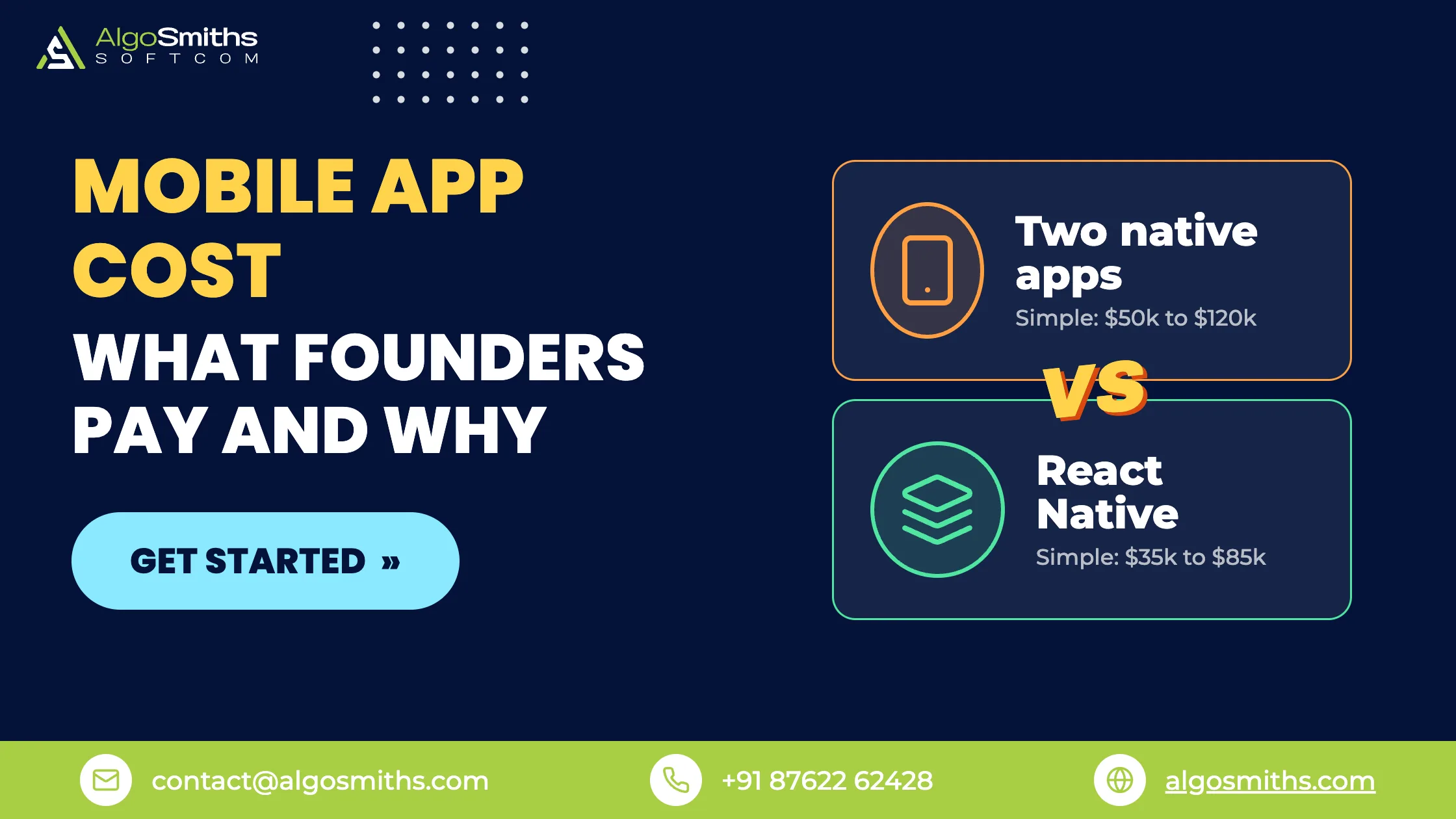
- GoodFirms prices a simple React Native app at $35,000 to $85,000 and two separate native apps at $50,000 to $120,000.
- Apple charges 99 US dollars per membership year. Google Play charges a one-time fee of 25 US dollars.
- GoodFirms puts yearly maintenance at 15% to 25% of the project budget, so plan the second year before you sign the first quote.
- Our Scale package, which covers iOS and Android apps, starts at $12,999 and runs in phases from four weeks up.
How much does mobile app development cost in 2026?
Plan for $15,000 to $40,000 for a basic app at market rates, and more as you add live data, payments or roles. The table shows the tiers from the GoodFirms report, which draws on 267 mobile app development companies and public benchmarks.
| Tier | What it includes | Time to build | Cost |
|---|---|---|---|
| Basic | Sign-up and login, profiles, simple screens, basic push notifications | 3 to 6 months | $15,000 to $40,000 |
| Mid-level | Custom design, live data updates, payments, outside APIs, analytics | 6 to 9 months | $40,000 to $120,000 |
| Advanced | Chat, subscriptions or wallets, AI features, offline sync, several roles | 9 to 12 months | $100,000 to $250,000 and up |
| Enterprise | Compliance work, links to ERP or CRM systems, heavy data processing, round-the-clock monitoring | 12 to 18 months and up | $250,000 to $500,000 and up |
These are market figures for planning. Our starting price sits below them: the pricing page lists Scale, the package that names iOS and Android apps, from $12,999. Each phase of a Scale project carries its own fixed price, and your scope decides how far above the starting figure you go.
Why do Clutch's numbers differ from each other?
Clutch's average of $90,780 sits above its most common range of $10,000 to $49,999. A gap like that suggests that a smaller number of large projects pull the average up, though the page does not give a reason. The same page gives a usual timeline of about 11 months and an average monthly cost of $8,188. Read the range as the typical project and the average as a warning about large scopes.
Native or cross-platform: which costs less?
For an app that must run on both phones, one cross-platform codebase costs less than two native apps. For an app that targets one phone, a native build can cost less than a cross-platform one. GoodFirms gives these ranges.
| Platform choice | Simple app | Mid-level to advanced app |
|---|---|---|
| Native iOS only | $25,000 to $60,000 | $60,000 to $150,000 |
| Native Android only | $28,000 to $70,000 | $65,000 to $150,000 |
| Separate native apps for both | $50,000 to $120,000 | $120,000 to $300,000 |
| React Native, both phones | $35,000 to $85,000 | $72,000 to $185,000 |
| Flutter, both phones | $33,000 to $80,000 | $40,000 to $100,000 |
The GoodFirms mid-level Flutter figure matches its figure for FlutterFlow, a low-code tool, so confirm that cell with a quote before you rely on it.
Clutch agrees on the direction. It reports that developers charge the same hourly rate whichever operating system you pick, and that two native apps double the price of a project. The saving comes from writing the screens and the logic once.
Do not pick a framework from the price table alone. Your team's skills matter more than the gap between the Flutter and React Native rows. Our comparison of React Native and Flutter for an MVP covers hiring, running cost, bug fixes and store rules.
Do you need a mobile app yet?
Ship a web app first when your users can do the core job in a browser. You skip store review and store accounts while you test demand. Build the mobile app when the job depends on the phone: push notifications your users act on, the camera, location, or work without a signal.
How does your team's location change the cost?
Hourly rates differ by several times between countries, and the total follows the rate. GoodFirms lists these hourly rates for cross-platform developers who work in React Native or Flutter.
| Country | Mid-level developer | Senior developer |
|---|---|---|
| United States | $70 to $110 | $110 to $170 and up |
| United Kingdom | $60 to $95 | $90 to $140 and up |
| Poland | $30 to $55 | $55 to $80 |
| India | $18 to $30 | $30 to $55 |
A low rate saves money when you write the scope down and the team shows you working builds each week. An hourly contract with a loose brief can cost more than a fixed price at a higher rate. Ask each vendor who will write the code and how senior that person is. Check which time zone they keep.
Which features raise the bill?
Features that need a server, an outside service or a second kind of user add the most work. Count them before you ask for a quote.
- Payments. Your team builds the checkout and handles failed charges. Digital goods bring store rules with them.
- Chat and live updates. The team has to keep messages in order when phones drop offline.
- Offline sync. Developers must decide which copy wins when two devices edit the same record.
- Several user roles. Each role brings its own screens and permissions to test.
- AI features. Model calls add build work and a monthly usage bill. Our guide to AI app development cost sizes both.
- Health or card data. Privacy and security rules add design and audit work.
Where does the budget go inside a project?
Frontend and backend work take the largest shares. GoodFirms splits a project budget as follows.
| Phase | Share of budget |
|---|---|
| Planning | 5% to 10% |
| Interface and experience design | 10% to 20% |
| Frontend development | 25% to 35% |
| Backend development | 25% to 35% |
| Testing | 10% to 15% |
| Deployment and launch | 5% to 10% |
Question any quote that has no line for testing or release work. A managed backend such as Supabase or Firebase can shrink the backend line for a first version.
What do you pay besides the build?
You pay for store accounts, hosting, maintenance and, if you sell inside the app, store commissions.
Store accounts and commissions
- The Apple Developer Program costs 99 US dollars per membership year, with local prices in some regions.
- A Google Play developer account carries a one-time registration fee of 25 US dollars. Google asks personal accounts created after 13 November 2023 to run a closed test before they publish, with at least 12 testers who stay opted in for 14 days in a row.
- Apple's Small Business Program sets a 15% commission on paid apps and in-app purchases for developers who earned up to 1 million US dollars in proceeds in the prior calendar year, and for new developers. You have to enrol.
- Google sets its service fees by region and programme. Read its current fee page before you price a subscription.
Register both accounts in your company's name, so the app stays yours if you change vendors.
A first-year budget you can copy
Take a basic app quoted at $40,000, the top of the GoodFirms basic tier. Add one year of upkeep and the fixed fees.
| Line | Low case | High case |
|---|---|---|
| Build | $40,000 | $40,000 |
| Maintenance at 15% or 25% | $6,000 | $10,000 |
| Apple membership, one year | $99 | $99 |
| Google Play registration | $25 | $25 |
| Supabase Pro plan, 12 months at $25 | $300 | $300 |
| First year | $46,424 | $50,424 |
The hosting line is a floor. Extra compute and traffic raise it, as our breakdown of Supabase pricing shows. The table leaves out marketing, legal work, new features and store commissions. If you hire us for upkeep, our care plan starts at $249 a month, which is $2,988 a year at the starting price.
How do you get a quote you can compare?
Send each team the same written scope and ask for a fixed price against it.
- Write the one job the first version does, in a sentence.
- List the screens and mark which ones the first users need.
- Name the platforms: iOS, Android or both.
- List each outside service, such as payments, maps, email or sign-in providers.
- Ask who owns the code, the design files, the store accounts and the server accounts.
- Ask what the price covers after release: bug fixes, store rejections, operating system updates and small changes.
Common mistakes
- Comparing headline numbers. One vendor prices a clickable prototype and another prices a released app. Compare the written scope.
- Building both platforms as separate native apps by habit. Check whether one cross-platform codebase meets your needs first.
- Leaving release work to the last week. A new personal Google Play account needs the 14-day closed test before it can publish.
- Spending the whole budget on version one. Hold back money for the changes your first users ask for.
Frequently asked questions
How much does a simple mobile app cost?
GoodFirms puts a basic app at $15,000 to $40,000 with a build time of 3 to 6 months. That tier covers login, profiles, simple screens and basic push notifications. A tighter first version with one workflow can cost less, so ask for a quote against your own list.
Is it cheaper to build for iPhone or Android first?
GoodFirms' ranges for a native iOS app start a little lower than for a native Android app, and the two overlap for most of their width. Clutch reports the same hourly rate for both. Pick the phone your first users carry.
What does it cost to maintain a mobile app each year?
GoodFirms puts yearly maintenance at 15% to 25% of the project budget. On a $40,000 build that is $6,000 to $10,000. Store membership and hosting come on top.
Can you build a mobile app for under $10,000?
Clutch's pricing page shows a band of projects below $10,000, so some teams do. Expect a short screen list and a ready-made backend. Our own package that names iOS and Android apps starts at $12,999.
Set your app budget before you ask for quotes
Pick your tier from the first table and choose your platforms. Add a year of upkeep and fees. Send the same written scope to two or more teams and compare what each price covers. If you want a senior engineer to scope your app on a free call, see our mobile and cross-platform development service.
Topic: Building an MVP