OpenAI vs Claude API Pricing: A Startup Cost Model
On this page
OpenAI and Claude API prices compared for a startup product: list prices, caching, long context and a worked monthly bill, read on 23 November 2026.
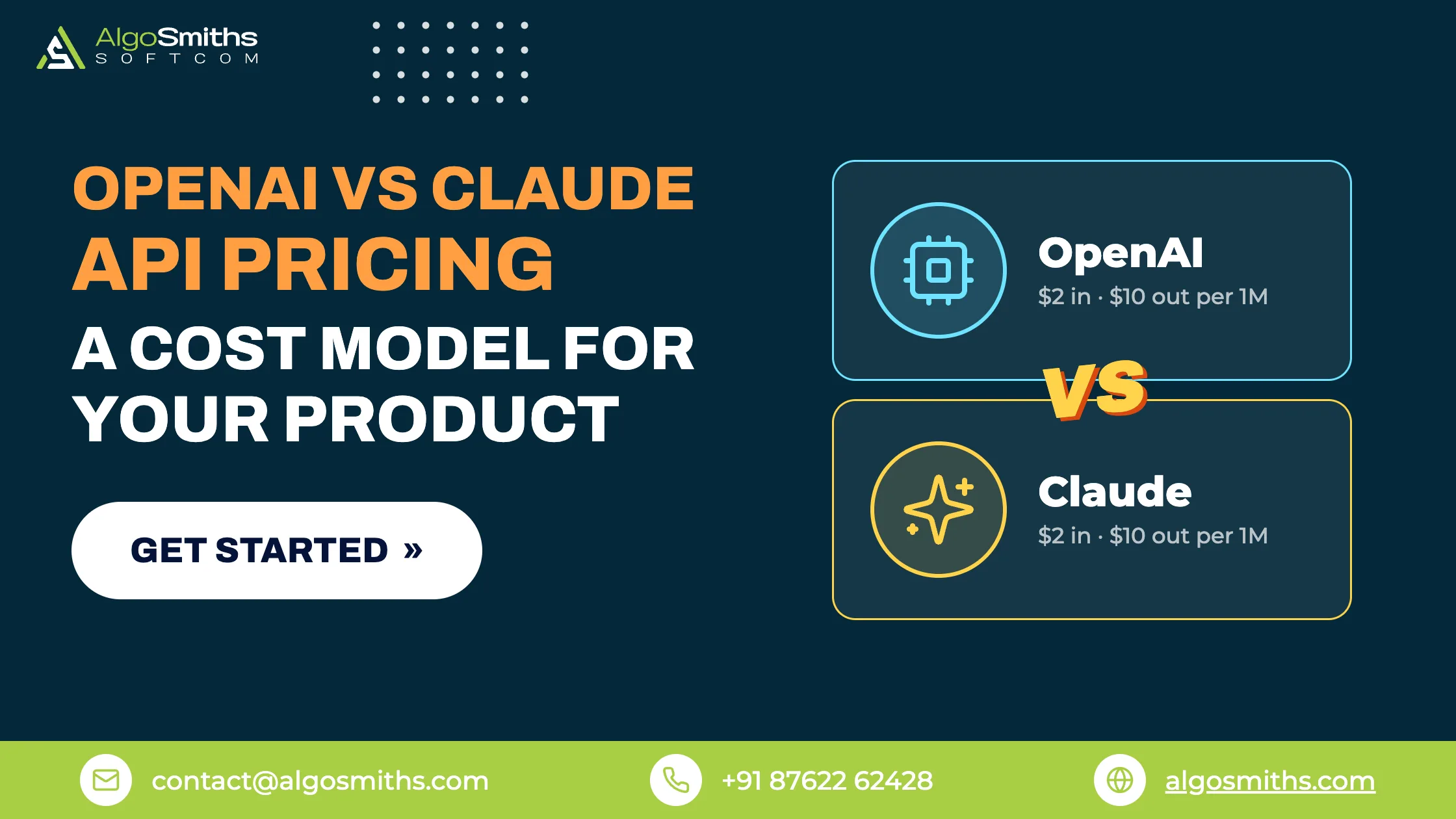
The OpenAI API price and the Claude API cost for a mid-tier model are the same on 23 November 2026: $2 per million input tokens and $10 per million output tokens. List prices line up tier for tier, so the monthly bill for your product depends on how you cache and how long your prompts run more than on the headline rate. This guide is for founders who must pick a provider or budget an AI feature. It uses the pricing and caching pages from Anthropic and OpenAI, read on 23 November 2026, and builds one worked cost model that you can copy.
Key takeaways
- Claude Sonnet 5.5 and gpt-6.2-sol each cost $2 per million input tokens and $10 per million output tokens, and the small and top tiers match as well.
- Prompt caching cuts the mid-tier example bill from $660 to $361.20 a month on either vendor, a saving of almost half.
- Context length opens the largest gap. Claude Sonnet 5.5 bills one rate across its 1 million token window, while OpenAI bills the full request at higher rates above 272,000 input tokens.
- The default cache window runs 5 minutes on Claude and 30 minutes on OpenAI, and the two vendors count tokens in different ways, so measure both on your own traffic.
How do OpenAI and Claude list prices compare?
We pair models by price and make no claim about quality. Test both on your own task before you treat two models as equals. The table shows the price per million tokens for four pairs that cost the same or close to it.
| Tier | Claude model | Claude input / cache read / output | OpenAI model | OpenAI input / cached input / output |
|---|---|---|---|---|
| Small | Haiku 5.5 | $0.10 / $0.01 / $0.50 | gpt-6-luna | $0.10 / $0.01 / $0.50 |
| Lower middle | Haiku 4.5 | $1 / $0.10 / $5 | gpt-6.1-terra | $1 / $0.05 / $5 |
| Middle | Sonnet 5.5 | $2 / $0.10 / $10 | gpt-6.2-sol | $2 / $0.10 / $10 |
| Top | Fable 5.2 | $8 / $0.20 / $40 | gpt-6.2-astra | $8 / $0.40 / $40 |
Both vendors sell models above and below these four. Opus 5.5 costs $4 for input and $20 for output on Anthropic's page, and gpt-5.5-pro costs $30 and $180 on OpenAI's page.
Prices move, so date every number in your cost model. OpenAI's page lists promotional pricing on GPT-5.6 Sol that runs until 30 November 2026. Anthropic dropped the planned rise to $3 and $15 on 1 September 2026, so the introductory $2 and $10 price for Sonnet 5 became its standard price.
What does a startup workload cost on each vendor?
Our guide to LLM API costs explains how token pricing works and what common features cost per user. This guide compares the two vendors on one new workload.
Take a document Q&A feature with 30,000 requests a month. Each request sends a 6,000-token prefix of instructions and an output schema, plus 2,000 tokens of retrieved passages and the user's question, and returns 600 tokens. That adds up to 240 million input tokens (180 million of them in the repeating prefix) and 18 million output tokens a month. These numbers are assumptions for the model, so replace them with your measured values.
Without caching, the mid tier costs 240 million × $2 = $480 for input plus 18 million × $10 = $180 for output, a total of $660 a month.
| Tier | Claude per month | OpenAI per month |
|---|---|---|
| Small (Haiku 5.5, gpt-6-luna) | $33 | $33 |
| Lower middle (Haiku 4.5, gpt-6.1-terra) | $330 | $330 |
| Middle (Sonnet 5.5, gpt-6.2-sol) | $660 | $660 |
| Top (Fable 5.2, gpt-6.2-astra) | $2,640 | $2,640 |
The model tier moves the bill more than the vendor does. The mid tier costs 20 times the small tier on the same traffic, and the top tier costs 80 times the small tier. Try the small model on twenty real inputs before you pay for a larger one.
How much does prompt caching change the bill?
Caching lets the vendor reuse the part of your prompt that repeats, such as instructions and a schema. Both vendors charge a premium to write an entry and a steep discount to read it, as the Anthropic prompt caching documentation and the OpenAI prompt caching guide describe.
- Anthropic charges 1.25 times the base input price to write a 5-minute entry and 2 times for a 1-hour entry. A read costs 0.05 times the base price on Sonnet 5.5 and 0.025 times on Fable 5.2. A 5-minute write pays back after one read.
- OpenAI charges 1.25 times the input price for a write with the default 30-minute lifetime and 2.5 times for a 12-hour lifetime. A read costs 0.05 times the input price on gpt-6.2-sol and gpt-6.2-astra.
Both vendors set a minimum prefix length for caching: 512 tokens for Sonnet 5.5 and 1,024 tokens for GPT-5.6 and later models. The 6,000-token prefix in the example clears both limits.
Assume a 90% cache hit rate on the prefix. In a month, 27,000 requests read the prefix from cache (162 million tokens), and 3,000 requests rewrite it (18 million tokens). The 60 million tokens of variable input pay the full input price.
| Line | Mid tier, either vendor | Claude Fable 5.2 | OpenAI gpt-6.2-astra |
|---|---|---|---|
| Variable input, 60 million tokens | $120 | $480 | $480 |
| Cache reads, 162 million tokens | $16.20 at $0.10 | $32.40 at $0.20 | $64.80 at $0.40 |
| Prefix writes, 18 million tokens | $45 at $2.50 | $180 at $10 | $180 at $10 |
| Output, 18 million tokens | $180 | $720 | $720 |
| Total per month | $361.20 | $1,412.40 | $1,444.80 |
Caching removes almost half of the $660 mid-tier bill on both vendors, because Sonnet 5.5 and gpt-6.2-sol charge the same $2.50 per million tokens for a default write and the same $0.10 for a read. At the top tier the totals differ by $32.40 a month, and the gap comes from the read price. One billion cached tokens read cost $200 on Fable 5.2 and $400 on gpt-6.2-astra. A workload that re-reads a large cached context on every step is where that difference grows. If your product runs agent loops, read our guide to AI agents for startups before you size the budget.
The cache window matters as much as the price. A Claude entry lasts 5 minutes by default, and each read refreshes it at no charge. An OpenAI entry lasts 30 minutes by default. If your requests arrive 10 minutes apart, the Claude default entry expires between them, and you pay 2 times the input price for a 1-hour write to keep it. Check the gaps in your own traffic before you assume a 90% hit rate.
Where do the two vendors differ on price?
How does context length change the price?
Anthropic's page states that Claude 4.6 and later models, except Haiku 5.5, include the full 1 million token window at standard pricing, so a 900,000-token request bills at the same per-token rate as a 9,000-token one. OpenAI's gpt-6.2-sol model page states that for requests above 272K input tokens, input and cache rates double and output costs 1.5 times the short-context rate for the full request. That makes the long-context rates $4 for input and $15 for output, against $2 and $10 below the line. For gpt-6.2-astra they are $16 and $60, against $8 and $40.
Claude Haiku 5.5 is the exception on Anthropic's side. A request with a prompt over 100,000 tokens pays $0.50 for input and $2.50 for output, five times the $0.10 and $0.50 below that size.
Take 1,000 requests a month with 400,000 input tokens and 2,000 output tokens each, such as long contract reviews. Sonnet 5.5 costs 400 million × $2 = $800 for input plus 2 million × $10 = $20 for output, $820 in total. gpt-6.2-sol at its long-context rates costs 400 million × $4 = $1,600 plus 2 million × $15 = $30, $1,630 in total.
Sending fewer tokens beats finding the cheapest long-context rate, and retrieval is the usual way to do it. Our guide to RAG for startups covers that approach.
Do the two vendors count tokens the same way?
Not always. Anthropic's page states that Claude 4.7 and later models use a newer tokenizer that produces about 30% more tokens for the same text than earlier models. OpenAI's page gives no tokenizer comparison. If one vendor's tokenizer turns your prompts into 30% more tokens at the same list price, the $480 input line of the mid-tier example grows to $624. Run your own prompts through each vendor's token counter, because a per-token price comparison covers half of the picture. Anthropic's page points to its token counting endpoint for this.
What do batch and speed tiers change?
Anthropic's Batch API takes 50% off input and output tokens, which puts Sonnet 5.5 at $1 and $5. OpenAI's page lists most batch rates at half of standard, which puts gpt-6.2-sol at $1 and $5. Use batch for work that can wait, such as nightly summaries and backfills.
Speed carries a premium on both sides. Anthropic's fast mode for Opus 5.5 costs $8 and $40, double the standard $4 and $20. OpenAI's Fast tier for gpt-6.2-sol costs $4 and $20, double the standard $2 and $10. OpenAI lists an Ultrafast tier for GPT-6.2 Astra and Sol at 3 times standard through 28 February 2027 and 6 times from 1 March 2027. OpenAI's page says it will not add its Flex tier to new models.
What about data residency and built-in tools?
Both vendors add 10% for regional processing. Anthropic adds a 1.1 times multiplier to US-only inference on Claude 4.6 and later models. OpenAI adds a 10% uplift on regional endpoints for models released on or after 5 March 2026. Web search costs $10 per 1,000 searches on both pages, plus the tokens for the search content. These add-ons cost the same on both sides, so they do not decide the choice, but they belong in the model.
How do you build a cost model for your own product?
Use one formula for every vendor and tier:
monthly cost = (variable input × input price)
             + (cache reads × cache read price)
             + (cache writes × cache write price)
             + (output × output price)
Fill it in with these steps:
- Send 20 real inputs to each vendor and record the input and output tokens from each vendor's own counter.
- Split the input into the part that repeats on every request and the part that changes.
- Take each line times your monthly request count, with a cache hit rate that you can log.
- Use the batch discount on the share of work that can wait.
- Re-read both price pages each month and update the dated numbers.
Put the model call behind one function in your code, so a vendor switch becomes a configuration change.
When should price stop deciding the choice?
Matched list prices mean you can pick on other grounds. Answer quality on your task, latency, rate limits and data terms each matter more than a few dollars of difference at this price level. Run both vendors on the same 20 inputs and score the answers before you commit.
What should you check before launch?
- A cost model that names the price page date for each number.
- Token counts measured on real prompts for the vendor you chose.
- Caching switched on for every prefix that repeats, with the hit rate logged.
- A cap on output tokens and a per-user quota. Our guide to rate limiting for startups covers per-user limits.
- A budget alert that warns you before the month ends.
Frequently asked questions
Which is cheaper, OpenAI or Claude?
At list price the matched tiers cost the same on 23 November 2026. The gaps appear in long-context requests, in top-tier cache reads and in how long a cache entry lasts, and both price pages change over time, so rerun the model before each budget review.
Do cache write fees change the comparison?
At the mid tier they do not. Sonnet 5.5 and gpt-6.2-sol both charge $2.50 per million tokens for a default write, so the worked example costs $361.20 on either. At the top tier the totals differ by $32.40 a month, and the read price causes that gap.
How much does the Batch API save?
Anthropic's Batch API takes 50% off both input and output tokens. OpenAI's page lists most batch rates at half of standard. Both discounts suit work that does not need an immediate answer.
Do both vendors count the same tokens for the same text?
Not always. Anthropic states that Claude 4.7 and later models produce about 30% more tokens for the same text than earlier ones. Measure your own prompts with each vendor's counter.
How often do these prices change?
Both pages show recent changes. OpenAI lists a promotion on GPT-5.6 Sol that ends on 30 November 2026, and Anthropic made its introductory Sonnet 5 price permanent. Check the pages again each month and date every figure you use.
Summary
Matched OpenAI and Claude models cost about the same per token, so your bill depends on how well you cache and how long your prompts run. Build the cost model from your own prompts and date each price. If you want an engineer to cost an AI feature before you build it, our AI, ML and data service covers production AI, from LLM apps to data pipelines, built by senior engineers.
Topic: AI features in production